

Not long after the city closed New York City public schools in March, May Huang and a team of parents in the largely Asian neighborhood of North Flushing in Queens were already thinking about how to get their school's classrooms ready to reopen in the fall. Led by the principal of P.S. 32, a group of 14 stakeholders, which included parents and teachers, dutifully kept up their school leadership team meetings on Zoom during the spring. They were only required to convene once a month, but they scheduled additional meetings because there was so much to discuss.
It would be months until Mayor Bill de Blasio announced his school reopening plan. Under the city's hybrid learning plan, which is set to start in less than a week on Monday, September 21st, students can elect to attend classes in person for one to three days a week, an unprecedented step for a major school district in the country and also one that is testing the trust of parents in the public school system.
A mother of two who works as attorney, Huang grew up in New York City and has sentimental ties to the public school system. She and her husband, an anesthesiologist, who are both the children of Chinese immigrants, met at Stuyvesant High School. When the pandemic shut schools and businesses down, she considered herself fortunate to be able to work from home and help their 7-year-old daughter and 5-year old son. But she also desperately wanted schools to reopen, a feeling that she said was shared by the other parents on the school leadership team.
"I was pushing to send my kids back," she recalled.
Throughout the spring and summer, she and others asked almost every conceivable question: Will there be enough teachers? Where will kids eat? How will the school perform contact tracing? And what happens when a child needs to go to the bathroom? How will those contacts be tracked?
Listen to Elizabeth Kim discuss this story on WNYC:
And in almost every instance, she said, school officials came up with a plan. "The administration and the principal and staff were really dedicated," she said. "They were really trying their hardest to decide how do we do this for next year."
But as the city's first soft deadline for families to submit their choice for remote-only learning approached on August 7th, Huang began having second thoughts. As a doctor, her husband was especially wary of the unknowns and the virus's uncanny ability to surprise experts. They also considered the fact that their children regularly saw their grandmothers, one of whom was still caring for her own 90-plus-year-old mother. They both wanted the kids to maintain those connections. She, meanwhile, could keep working from home.
In the end, the two sat down, and in her words, "did a lot of soul searching." They decided to keep their children at home.
As it turned out, Huang was not alone. Despite the fact that the positive testing rate for coronavirus has remained below 2% for two months, the number of New York City public school parents refusing to send their kids to schools on the first day has grown with each passing week. As of Friday, 42%—or about 422,190 students out of more than 1 million—are planning to learn exclusively online.
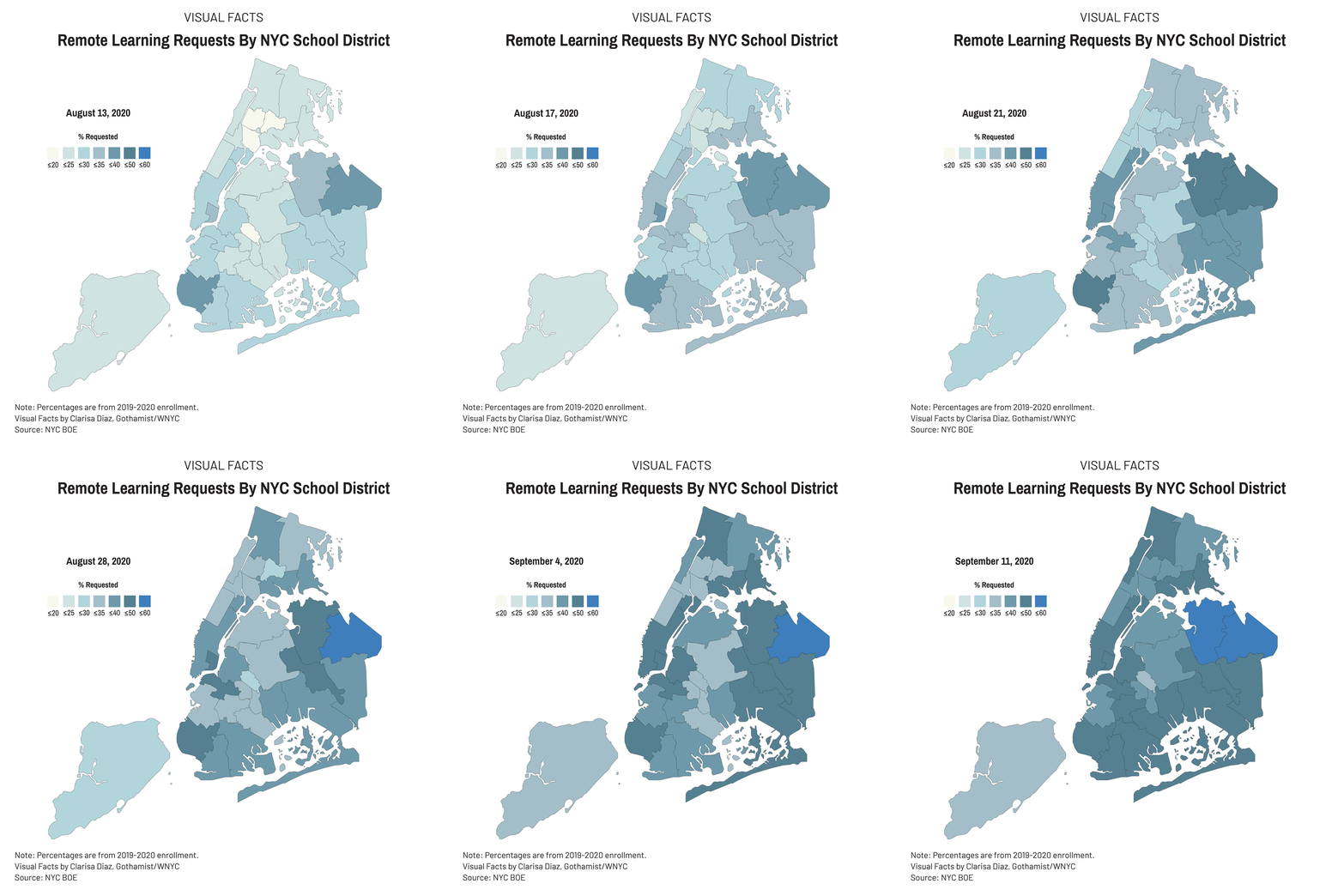
The first time Mayor Bill de Blasio announced the breakdown, on August 10th, the share of online learners stood at 26%. With parents able to drop out of blended learning at any point, the final tally could become even higher. Should infections among school members continue to pop up as they already have, in-person attendance at many schools could eventually drop below 50%.
The preference for remote-only instruction has been most pronounced among Asian public school families, where 59%—or roughly 6 out of 10 students—have opted out of in-person learning. Making up 18% of all city public school students, Asians outnumber whites, who are choosing remote 29% of the time.
Blacks and Hispanics, who make up 63% of students, have remote learning rates of 40% and 39% respectively.
In the context of the pandemic's impact, all of these trends seem rationale. Blacks and Hispanics have been disproportionately hurt by the virus, with low-income communities of color experiencing the highest covid rates—and in the beginning at least, the least amount of testing. Although Asians have had the lowest infection group by race or ethnicity, the fact that coronavirus originated in China has heightened their awareness about its dangers.
Through her network, Huang knew that many of the Chinese parents at her school were choosing to keep their children home. P.S. 32 has roughly 1,000 students, 70% of which are Asian. The public school has been touted as being the first on the East Coast to have a Korean dual language program.
P.S. 32 sits in District 25, which along with District 26, lead all others with the highest share of students enrolling in remote learning— 52% and 56% respectively. Based on testing and ratings by school assessment websites, they have some of best schools in the city. Both districts, which include Flushing, Whitestone, Bayside, and Douglaston, have a student population that is roughly half Asian.
To stay in touch with many of the parents at her school, Huang joined a group on WeChat, a Chinese messaging app, even though she doesn't read the language. But she can decipher any Chinese text using the app's translation feature.
It was through WeChat that she learned in March that Chinese parents were already sending their children to school in masks. As the mayor argued with the teachers union over closing schools, Asian parents had already decided to keep their kids at home.
Huang put masks on her own children and did not send them to school on Friday, March 13th. By then, attendance had already looked sparse. The following weekend, Governor Andrew Cuomo and de Blasio announced that New York City schools would close. (De Blasio said New Yorkers should wear masks outside on April 2nd, while Cuomo would not issue any sort of mask guidance until April 15th.)
According to Amy Tse, whose daughter graduated in June from a public middle school in Fresh Meadows, which is in District 26, Asian parents in Queens acted early in response to the virus, even before the first infection was confirmed in the city on March 1st.
Even outside the school community, Chinese New Yorkers across the city seemed to be on high alert. Some began donning face masks as early as January, drawing quizzical stares and in some cases racist attacks. As Tse noted, mask wearing is "a cultural thing." Asians, who have weathered previous viral outbreaks in recent history, often see the measure as a public health courtesy to others.
"They were aware of it and they took it very seriously, she said, adding, "We went through SARS. Everybody was very sensitive to the fact that this is a pandemic and you have to wear a mask."
People in Flushing wearing face masks in January, 2020
Meril Mousoom, a rising senior at Stuyvesant High School, said she noticed many of her East Asian classmates wearing masks in March before schools closed. At Stuyvesant, 74% of the students are Asian.
Mousoom, who is South Asian and commutes three hours roundtrip from Jamaica, Queens to her school in Lower Manhattan, said the fear of transmission was already palpable among some of her Chinese friends. "A lot of my friends said their parents won't let them out of the house," she remembered.
As a student, she has organized protests against the city's school reopening plan, arguing that the unanswered questions about protective equipment, nurses, testing and ventilation add up to a "fallacy" that schools are safe to reopen.
One Chinese mom at P.S. 32 who asked to go by her last name Liu, said her decision to keep her daughter at home boiled down to safety, which she said was her biggest concern. She worried about the long-term effects and expressed doubts about a vaccine, wondering if it would even work. "I don't want kids to take this kind of risk," she said.
She plans to keep her daughter home for the entire year.
The prevalence of multi-generational households in Asian communities has also been a factor. According to Pew Research Center, Asians and Hispanics in the United States have the largest share of families where more than two generations live under one roof, 29% and 27% respectively. In many families, grandparents or other relatives serve as caretakers for their grandchildren, helping with drop-offs and pick-ups and after-school care.
Not surprisingly, risk of contracting the virus appears to increase with the number of family members. In April, a Gothamist analysis found a correlation between the average number of people living in a home together and the number of coronavirus cases in zip codes around New York City.
One Chinese mother in District 26, who asked not to be named for privacy reasons, said she decided to sign up her daughters for remote-only learning in large part because her two elderly parents lived with them. Both have significant health issues: one has diabetes, while another is recovering from a brain tumor.
"For my kids to go to school and be in a classroom with many kids," she said, "That's like added risk for the grandparents."
Among older students, the reasons go beyond health. Franco Scardino, a 20-year social studies teacher at Townsend Harris High School in District 25, said academics are at stake, especially at competitive schools like his. The school, whose student body is 68% Asian, boasts a long and storied history, with a list of esteemed alumni that includes Jonas Salk, the American virologist who invented the vaccine for polio.
According to Scardino, a staggering 90% of students at Townsend Harris have selected the full-remote learning option. Although he acknowledged that health concerns were likely on the forefront of the minds of many families, he said students were also thinking about course offerings. Under the hybrid model, which calls for staggered schedules to accommodate social distancing rules, there are simply not enough teachers to teach all the courses, particularly advanced electives, in person. Because of those staffing issues, Townsend Harris was forced to cut some in-person classes.
"Our school would have needed 36 additional teachers and we’re just one high school," he said, adding that the city's specialized high schools like Stuyvesant, Bronx Science and Brooklyn Tech faced similar challenges.
"Students and parents who are looking at the situation [think] 'well, my student is going to get a lot more instruction if they go remote, so I’m going to choose remote.'"
In July, Stuyvesant asked the DOE in July for permission to go toward an all-remote model. Its request was turned down.
Mousoom, the Stuyvesant student, said there was a lot of concern expressed on the school's Facebook groups about courses being removed. She read essays from students on why the school should go fully remote. In addition to her concerns about safety, she had another reason for choosing remote: it would distance her somewhat from the pressure cooker environment Stuy is known for.
Huang also discovered a scheduling wrinkle with in-person schooling for her children's school's gifted and talented program. There was demand only enough to have one in-person G&T class per grade, and the 1st and 3rd graders were put in different cohorts, meaning that her son and daughter would have had to go to school on different days. She said school administrators said they would try to remedy such situations but by then, she and her husband had already made up their minds.
Looking back, she and others had approached the school's reopening with an impressive level of intrepidness. Shortly after the school term officially ended in June, the principal arranged for permission for their group to hold a socially distanced meeting inside the elementary school's auditorium. They arrived, all wearing masks. Later, they toured each classroom, armed with a spreadsheet that showed the square footage of each room and how many students were in each grade.
This was before the mayor had even unveiled the details of his plan.
"I know the school is trying its best," she said. "I’m hopeful that if it goes well I will send my kids back."


