
It's been almost a month since the New York City Board of Elections released its unofficial tally of the 2020 Presidential Election. After counting 662,314 absentee and military ballots (a new record), 33,980 affidavit ballots, and 24,596 ballots that fell into other categories, the BOE released its official results on Tuesday, certifying that President-elect Joe Biden won the city with a total of 2,321,759 votes. That's 1,630,077 more votes than the 691,682 President Donald Trump received.
Of the newly counted votes, more than three-quarters went to Biden, mirroring the trend seen around the country of Democrats making far more use of absentee voting than Republicans.
Let's look at the new map of official tallies below:
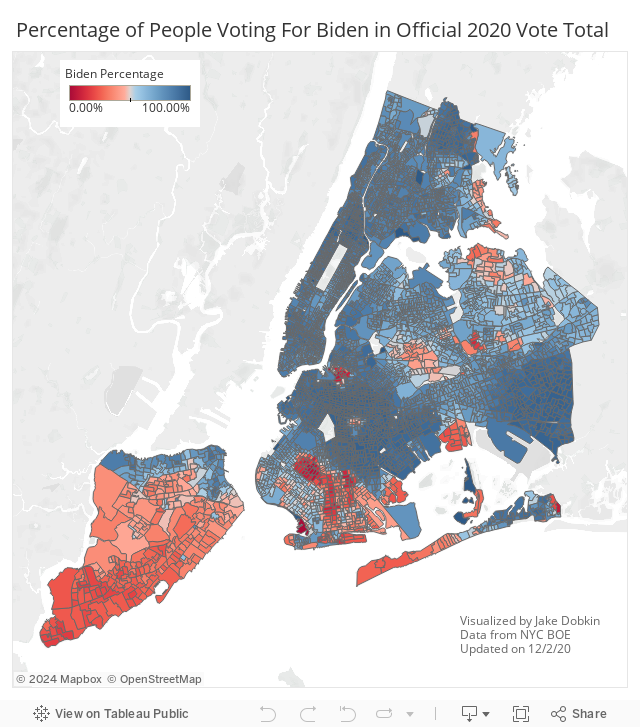
Compared to the unofficial map, not much has changed geographically, with Biden enjoying overwhelming dominance across the city, except on Staten Island. We still see Orthodox Jewish enclaves in Borough Park, Crown Heights, and Williamsburg voting decisively for Trump, as did other traditionally conservative areas like Breezy Point, Broad Channel, and Howard Beach in Queens. In the Bronx, only a few neighborhoods along the eastern edge of the borough, like Throgs Neck, went for Trump.
Let's examine the map of absentee voting:
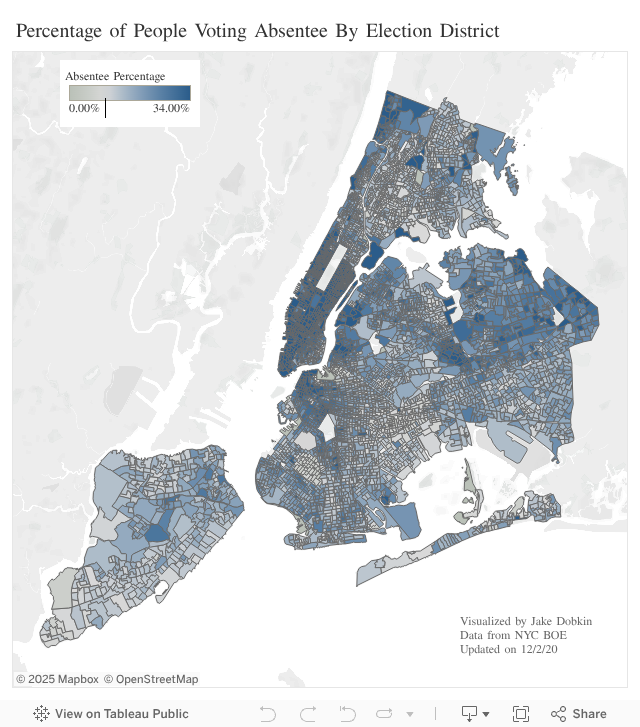
Here we see a clear pattern of wealthier areas of the city making more use of absentee voting, especially in Manhattan, brownstone Brooklyn, and the gentrified areas of Long Island City and Astoria in Queens. We also see areas with high numbers of Republican voters having lower percentages of absentee voting: look at that very light areas around Borough Park and in Staten Island.
Finally, let's look at the shift in votes from the previous unofficial totals, representing the impact of absentee voting:
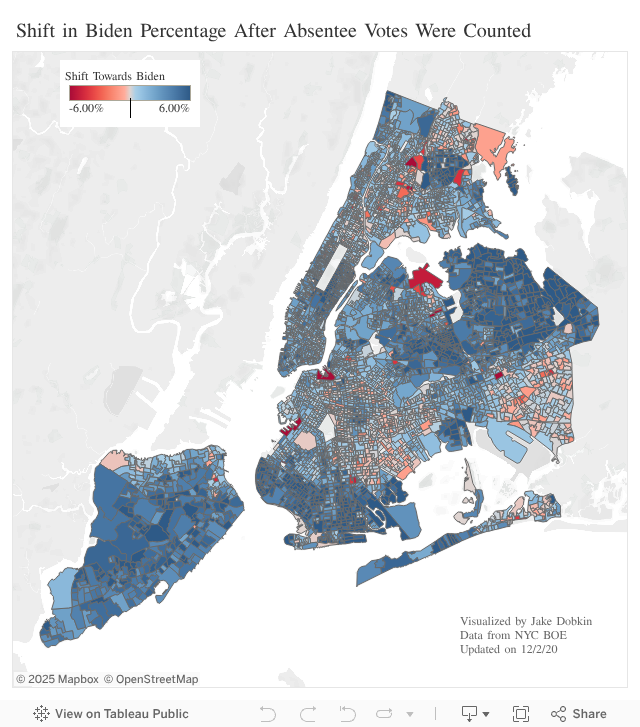
Here, there's a clear pattern of more conservative areas swinging several points towards Biden after the absentee votes were cast, while areas that were already heavily Democratic show smaller swings, or even moves, in the opposite direction. It will be interesting to see if these patterns hold in the 2021 citywide elections, when the pandemic rules allowing widespread absentee voting may be changed.


