

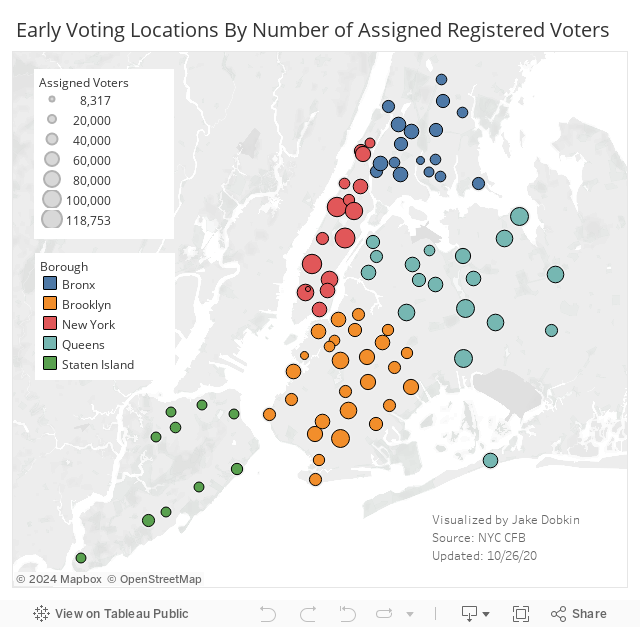
After five days of record-setting turnout, the New York City Board of Elections decided late Thursday to add an early voting site on Manhattan’s Upper East Side to alleviate the hours-long lines at Robert K. Wagner Middle School, the location with the most assigned voters in the city, as first reported by Gothamist / WNYC.
The new early voting site will be at Marymount Manhattan College for Saturday and Sunday only.
Adding Marymount comes as the closely watched presidential contest continues to draw tens of thousands of city voters each day. In response to the turnout, the Board expanded hours at the poll sites this weekend. But several city and state officials argued that was not enough. While the addition of the new site addresses the concerns of officials in Manhattan, it also stands to frustrate officials in other parts of the city whose constituents are still stuck waiting.
“One additional site is all well and good, the problem is much bigger than that,” said Michael Gianaris, Deputy Senate Majority Leader, who represents voters in Queens.
State Board of Elections Commissioner Douglas Kellner said it was clear Robert F. Wagner Middle School could not handle the roughly 120,000 voters assigned to that site. He visited the school on Wednesday with Assemblymember Rebecca Seawright, who is currently seeking re-election in the district and made a direct plea to Marymount Manhattan College.
Beyond insufficient staff and equipment available, Kellner repeated his criticism that the Board failed to conduct an accurate assessment of the site capacity, disputing their claim that it only takes approximately 30 seconds for voters to pass through the check-in tables, the source of the bottleneck during early voting causing the delays.
“That estimate is dead wrong,” said Kellner. He said the Board’s calculation leaves out the time it takes to print the voter’s ballot, which takes place at the same table, so that the total time from one voter to the next runs between one-and-a-half to two minutes.
“That means that they can only do 30 or 40 voters per hour at each station. And if you have eight stations, which is the maximum you can have at an early voting poll site, that's only 250 voters per hour. So I keep telling them, do the arithmetic if you only have 250 voters per hour,” he added.
The decision to add Marymount as a site came hours after the Board held a public meeting where they were expected to consider the additional site. Instead, they met publicly for six minutes to approve a poll worker retention bonus for those who agree to work the extended shifts set to begin on Friday and run through Sunday. They will receive an additional $150 if they work two of the extended days plus Election Day, or an additional $250 if they work all three and Election Day.
After approving the pay package, the commissioners moved to meet in a private executive session for over an hour to discuss “personnel” matters.
Assemblymember Seawright reached out to Marymount Manhattan College earlier this week about serving as a supplemental early voting site, according to college president Kerry Walk, who said they agreed immediately.
“MMC is proud to support the American democratic process and to protect the nation’s most fundamental right—the right to vote,” said Walk. The college, whose alumna include Geraldine Ferraro, served as a poll site during the June primary, and in previous elections over the past decade.
"Marymount Manhattan College will be used as an overflow early voting poll site on Saturday October 31st from 7 a.m. to 5 p.m. and Sunday November 1st from 7 a.m. to 4 p.m. Marymount Manhattan College had previously served as an Election day poll site for the June Primary; the Board had reached out to them for the November General, but the space was not available. We welcome their newfound interest in becoming a site and hope it extends past this election," said Valerie Vazquez-Diaz, Director of Communications & Public Affairs at the NYC Board of Elections, in a statement. "It is our hope that this additional site will alleviate voter traffic at Robert F. Wagner Middle School. At all early voting sites, seniors and voters with disabilities are directed to go the front of the line."
Seawright had threatened to take the city Board of Elections to court on Friday to compel them to add another site, arguing that they were violating state election law by forcing voters to wait more than 30 minutes to vote. In a statement late Thursday afternoon, she praised the Board’s decision.
“The voters of the Upper East Side, Yorkville, and Roosevelt Island are grateful to Marymount Manhattan College for stepping up in this time of crisis. We simply cannot tolerate voter suppression of any kind and this action is exactly what is needed,” Seawright said.
While the Board may be addressing the immediate issues in upper Manhattan, lawmakers say the overall planning for the 2020 election, and the lack of transparency about how the Board operates is still part of the problem.
“We needed to do a better job leading up to this election, getting more early voting sites,” said City Councilmember Ben Kallos, who served as chair as the committee on government operations during his first term on the Council and has been an outspoken proponent of reforming the Board’s policies and practices.
“If there is one thing people can remember after Election Day, other than who they voted for and who won is that they should not leave their elected officials alone until we have enough early voting sites,” Kallos added.
Elected officials in other parts of the city said the Board needed to do much more.
For more than a year, Senator Gianaris has pushed officials to expand the number of early voting sites in Queens, getting them up to 18 for this election, “and it’s still clearly not enough,” he added.
Gianaris, along with State Senator Zellnor Myrie, are proposing legislation that would require one early voting site per 25,000 voters. Under that new metric, all five boroughs would see an increase in poll sites: Queens would move from 18 sites to 48; the Bronx would go from 17 to 33; Brooklyn from 27 to 66; Manhattan from 16 to 48; and Staten Island from 10 to 13. In total, the proposal offers 208 early voting sites, more than doubling this year’s 88 locations.
The Mayor’s office continued to criticize the Board of Elections performance during this election this week with calls for an overhaul that would professionalize the management of the agency.
"The BOE and its Commissioners have the power to select early voting sites under election law, but have failed to use that power creatively,” said Jose Bayona, a spokesperson for Mayor Bill de Blasio.


